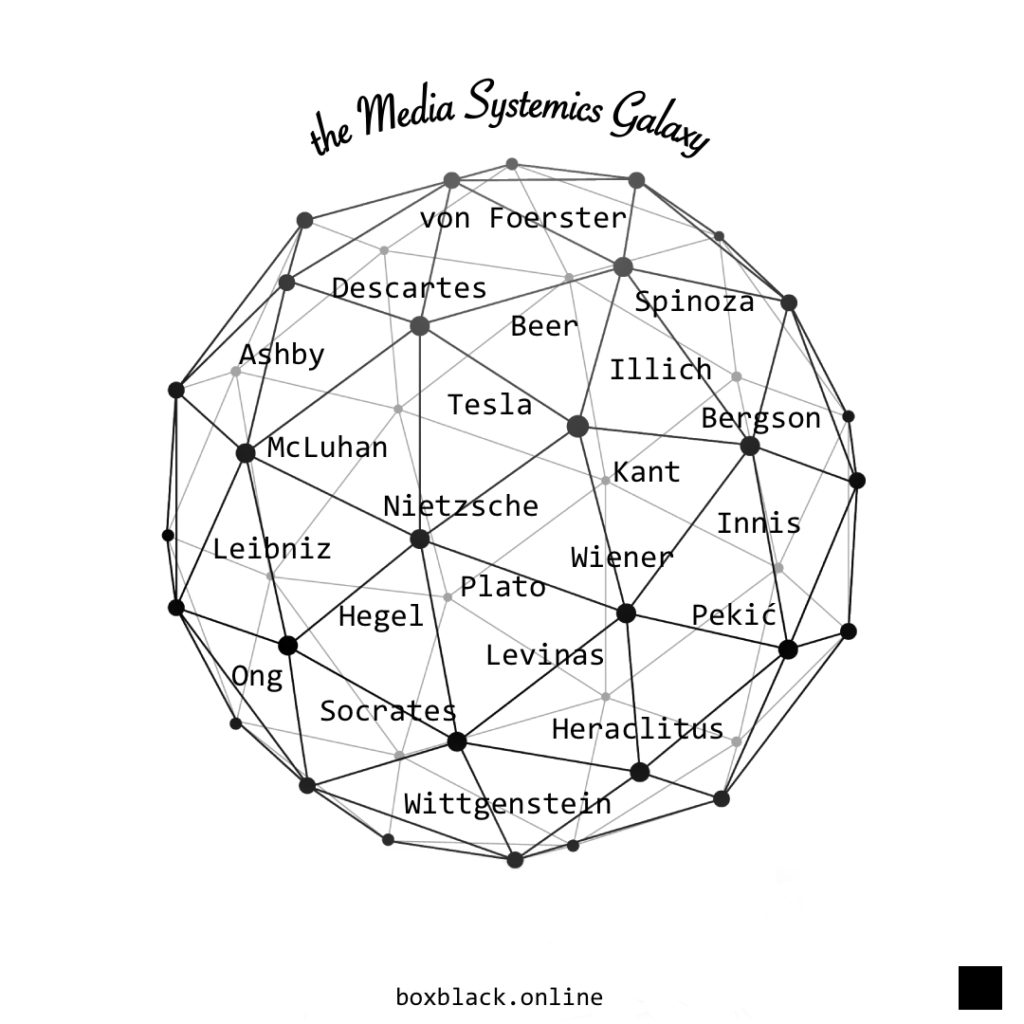
Media Systemics is a way of thinking and doing that combines essential elements from
philosophy, media theory and cybernetics to help leaders and teams navigate the digital epoch
more efficiently.
To propel you up the exponential learning curve we are radically shortcutting your route to
autonomy, discovery, and creative play.
Using intuitive models stemming from communication and adaptation processes inherent in all
living organisms and shared by machines, we exercise pattern recognition over history of
technological change linked with its social effects to design human-centered systems, where
response-ability emerges through learning by design.
#HERE’S HOW:
Is a comprehensive learning framework created to enhance organizational response-ability across various domains such as:
01> Communications
02> Management
03> Entrepreneurship
04> Research and development
05> Art & production
06> Ethical design
Constructed for your convenience, it consists of 5 complementary and autonomous Modules
made of 1-hour blocks, each equipping organizations and individuals with a fundamental
understanding and versatile tools for attaining response-ability, the ability to respond to change
by adapting ethically:
02> Management
03> Entrepreneurship
04> Research and development
05> Art & production
06> Ethical design
Constructed for your convenience, it consists of 5 complementary and autonomous Modules
made of 1-hour blocks, each equipping organizations and individuals with a fundamental
understanding and versatile tools for attaining response-ability, the ability to respond to change
by adapting ethically:
04> Research and development
05> Art & production
06> Ethical design
Constructed for your convenience, it consists of 5 complementary and autonomous Modules
made of 1-hour blocks, each equipping organizations and individuals with a fundamental
understanding and versatile tools for attaining response-ability, the ability to respond to change
by adapting ethically:
06> Ethical design
Constructed for your convenience, it consists of 5 complementary and autonomous Modules made of 1-hour blocks, each equipping organizations and individuals with a fundamental understanding and versatile tools for attaining response-ability, the ability to respond to change by adapting ethically:
MODULE_0:
Response-able Communication:
The Genesis Module [6 blocks/hrs]
The art and science of response-able communication distilled.
Craft your identity, forge your response. For communicators.
MODULE_1:
Response-able Media Systems:
Beyond Message [5 blocks/hrs]
Media dissected, redefined, and mastered. For creators, art managers, advertisers and
storytellers.
MODULE_2:
Response-able Management:
Complexity Riders [5 blocks/hrs]
Management, reimagined through the cybernetic lens. For strategists, visionaries, and leaders.
MODULE_3:
Response-able System Model:
The Shape of Systems to Come [5
blocks/hrs
Dive into the operational matrix. For architects of change,
designers of tomorrow
MODULE_4:
Response-able System Design:
Design Destiny [5 blocks/hrs]
Ethical systems, built to last. For innovators, guardians, and pioneers
For optimal performance and full-spectrum governance we recommend installing the entire Media Systemics Protocol (0-1-2-3-4). To rapidly onboard teams and integrate MSP effectively combine The Genesis Module with another one(s) of your choice, all Modules are interoperable and multipurpose
The Genesis Module
We’re not just talking communication; we’re shaping the DNA of dialogue and identity.
This is the bedrock on which everything else stands — the root platform designed for response-ability.
- All in One: Unfolding the MSP Schema [the map of change]
- Communication Technologies I [a very brief history of disruptions: speech, writing, alphabet, print]
- Communication Technologies II [telegraph, radio, television, internet]
- Response-able Communication Model [features, functions, structure, ethics]
- Response-able Organization Model [corporate identity formation, dialogical self model, response-able organization, reputation, the ACID test]
- Communication Field Design [workshop]
Management, Marketing, PR, Communication Designers, IT Professionals.
Provides an integrated communication platform that meets diverse organizational needs.
This module enhances skills in change management, disruption history, ethical communication practices, and reputation development, offering a comprehensive solution for internal and external communication field design.
Beyond Message
Beyond mere exploration; it’s a revolution.
- What are Media? [when we talk about media, what are we talking about?]
- Media as Extensions [human augmentations]
- Media is the Message [making the invisible visible]
- Media are Systems [welcome to the age of systems]
- The Laws of Media [McLuhan’s tetrad, the tool for gaining insight into human artifacts]
Media Professionals, Communication Strategists, Art & Production Teams, IT Professionals.
Enhances media literacy and strategic management using McLuhan’s Tetrad to predict and analyze media impacts, fostering effective yet response-able use of technology in various contexts and industries.
Complexity Riders
We’re not ruling; we’re unshackling — with rules.
This is where chaos meets order, complexity is curated, and leaders of the future are born.
- History and Origin of Cybernetics [science crafted for a healthy human/machine relationship]
- Basic Cybernetic Concepts I [black box/environment, feedback/feedforward, homeostat]
- Basic Cybernetic Concepts II [homeostasis/homeorhesis, autopoiesis, complexity/variety, decentralization]
- The Law of Requisite Variety [the underlying law of system management]
- Response-able Variety Management [workshop]
Executives, Managers across all levels, IT Professionals.
Teaches cybernetics principles applicable to management, promoting adaptive management skills suitable for complex system navigation and development.
Provides a measurable method for managing variety and complexity, tailor-fitted to your organization.
The Shape of Systems to Come
Here, the Viable System Model steps beyond a simple framework; it becomes the future cast into the present.
We’re engineering harmony between innovation and sustainability, crafting an organization model that is resilient, responsive, response-able — and staying well ahead of change.
- Introduction to the Viable System Model [liberating the movement of hands]
- The Operational Domain [System 1]
- Inside & Now [System 2 + 3]
- Outside & Then [System 4]
- The Metasystem [System 5]
Senior Management, Strategic Planners, IT Professionals.
Introduces the Viable System Model, enhancing skills in operational management and strategic foresight.
Focuses on requisite variety management — teaching how to effectively balance internal capabilities with external challenges and opportunities to maintain organizational stability and adaptability.
Design Destiny
Yes, we’re crafting systems — but also legacies. Systems designed to endure, empower, and excel.
Here, ethical design is animated in every decision and every innovation, embodying the balance between freedom and function.
- Kybernethik [Ashby’s Ethical Regulator: introduction]
- Defining the System [universe, CATWOE / TASCOI]
- System 1 [the elementary echelon]
- System 2 + 3 + 4 [regulation]
- System 5 [identity]
Senior Management, Strategic Planners, System Designers, IT Managers, Operations Managers.
Focuses on system design principles with a strong emphasis on ethical regulation and system management.
Includes practical application in response-able system design and development, equipping participants with the tools to create and manage adaptable and resilient systems within their organizations.